 IOSH
Asbestos
What it is, where it’s found and how to manage the risks
Asbestos exists in millions of buildings worldwide. The World Health Organization (WHO) estimates that 125 million people worldwide could be exposed to it. It poses a severe threat to people’s health when not managed properly. Workers can breathe in the fibres, which can become stuck in the lungs. Over time, this can cause serious illnesses, including fatal cancers.
Facts about asbestos
- 125 million people worldwide are thought to be exposed to asbestos in their workplace.
- Estimated 233,000 occupational cancer deaths caused by asbestos every year.
- Asbestos fibres are a thousandth of the diameter of a human hair. But you can see dust that contains fibres when asbestos-containing materials are damaged.
Types of asbestos
The common ones used were:
- chrysotile (white asbestos)
- amosite (brown asbestos)
- crocidolite (blue asbestos).
Anthophyllite, actinolite and tremolite asbestos were less commonly used.
Where asbestos can be found
- Asbestos millboard and papers – these have been used in specialist applications such as insulating electrical equipment and can contain high levels of asbestos.
- Asbestos yarns – used for fire protective clothing, gloves and fire blankets, ropes, gaskets and packing materials. Cloth containing asbestos has also been used in ceramic fuse holders behind fuse wires.
- Fibre cement – widespread use for roofing, wall cladding, soffit boards, boiler flues, gutters, pipes, tanks and bath panels. Fire bricks, lintels and surrounds were also made from asbestos cement.
- Floor tiles, gaskets, bitumen, felts – where floor tiles have been bonded to the floor using bitumen there is often a residue of fibres left in the bitumen when the tiles are removed.
- Insulating boards – these were produced to provide low-density, low-cost, fire-resistant insulation in many buildings. Asbestos can be found in ceiling tiles, partition walls, firebreaks, soffit boards and heater cupboards.
- Laggings – used to prevent heat loss or heat transfer to surrounding areas. Found on boilers, pipes and other plant items.
- Mastics, sealants, putties and adhesives – used in boiler systems to attach insulation or fill gaps.
- Reinforced plastics – including reinforced handles, automobile parts, housing for electronic equipment and toilet cisterns.
- Spray coatings – used for fire protection on structural steel beams, trusses and girders, but also to prevent condensation inside buildings and for acoustic control. The coating comprised a thin layer of cement and fibre mixture applied by high-pressure spray.
- Textured coatings and paints – often used to decorate walls and ceilings.
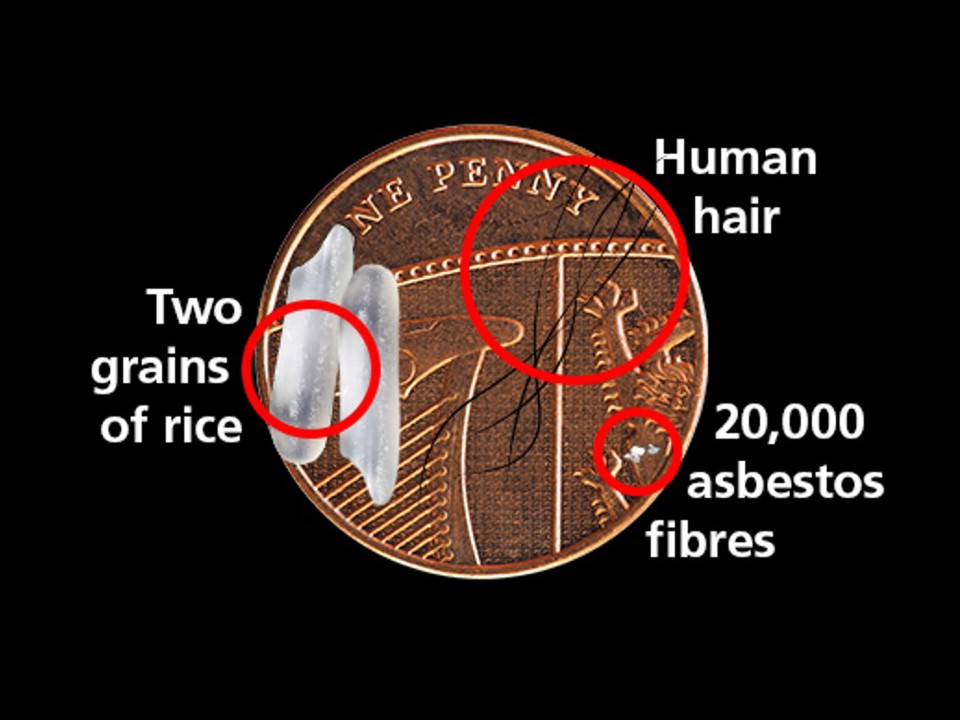
How small is asbestos?
To get an idea of just how small asbestos is, this image shows 20,000 asbestos fibres compared to grains of rice and a human hair.
What’s the issue and who’s at risk?
Exposure to asbestos is a higher risk for those who work in:
- mining
- construction
- civil engineering
- agriculture
- automotive
- thermal
- boat building
- ship breaking
- mechanics
- industrial sectors.
Workers in these sectors usually encounter asbestos during maintenance, refurbishment or demolition activity.
In countries where asbestos is still used, other workers will be exposed, especially those involved in the manufacture, use or installation of products using asbestos-containing materials.
Plus, workers involved with infrastructure construction, emergency services or clean-up operations after a natural disaster will be at risk of occupational exposure to asbestos.
Harmful effects from asbestos have been reported in medical papers since 1924. But it was not until 1955 that breathing in asbestos fibres was shown to cause lung cancer and, in the 1960s, mesothelioma.
Blue and brown asbestos are the most harmful, but white asbestos can also cause asbestos-related diseases.
“I remember all too well when my late husband Alan was diagnosed with mesothelioma. We at that time didn’t know asbestos hadn’t been banned in the United States. So, for the past 20 years, our family and many others have worked to prevent asbestos exposure through educational campaigns and policy to finally ban it.”

Linda Reinstein
- Job role
- President and co-founder
- Company
- Asbestos Disease Awareness Organization
Abestos-related diseases
-
This lung condition can occur when asbestos fibres breathed into the deepest parts of the lungs cannot be removed by the body’s defences. They damage cells that are usually repaired by the body, creating scar tissue. This process is called fibrosis. It shows up as mottled spots or smears on x-rays. Scarring destroys lung tissue and reduces the lung’s ability to take in oxygen.
It can cause pain and breathlessness. Asbestosis usually occurs by breathing in fibres over many years. However, it can also be due to high-concentration exposures of a short duration. Generally, the greater the concentration of asbestos dust and the number of years a person is exposed, the higher the chance of developing asbestosis.
-
This is a malignant lung tumour characterised by uncontrolled cell growth in lung tissues. Most primary lung cancers are carcinomas, which produce common symptoms of coughing (including coughing up blood), weight loss, shortness of breath and chest pains.
-
Asbestos fibres can also affect the lining of the lungs, causing the development of a malignant and incurable cancer called mesothelioma. This tumour causes fluid build-up in the pleura and pain in the chest. Deaths from mesothelioma typically occur 20 to 40 years following exposure.
Asbestos can also cause scarring to the pleura or a build-up of fluid in this space in the lungs. While pleural plagues are benign, they can sometimes cause pain and difficulty in breathing and may need to be removed surgically.
Research, carried out between 1971 and 2005 in the United Kingdom, found that asbestos causes lung disease and that if the worker is also a smoker, this significantly increases the risk. Any co-exposure to tobacco smoke and asbestos fibres increases the risk for lung cancer (Frost G, Darnton A, Harding AH. The effect of smoking on the risk of lung cancer mortality for asbestos workers in Great Britain (1971–2005). Annals of Work Exposures and Health 2011; 55(3):239-247).
The International Agency for Research on Cancer (IARC) has reaffirmed that all types of asbestos can cause cancer. In addition to lung cancer and mesothelioma, it identified two other types of cancer that are caused by asbestos: larynx and ovarian. Medical evidence shows that other cancers linked to asbestos can include peritoneal, bowel, stomach and throat.
How to manage asbestos
The risk of contracting an asbestos-related disease depends on the asbestos type, concentration of fibres in the dust, duration of exposure, susceptibility of the individual and time since the first exposure.
Most countries require that people are not exposed to any airborne asbestos fibres, as there is no safe level of exposure. However, countries have different views on what limits to set for occupational exposure values for both eight-hour and short-term (15 minutes) exposure periods.
The asbestos limit values per country table on the German Social Accident Insurance website shows action should be taken to prevent or control asbestos exposure if a limit is reached. In Australia, for example, this is when 0.1 fibres are detected per CM3 of air averaged over a specified period (eight hours). It's important to state that any potential asbestos exposure should, at first, be prevented.
In the United Kingdom for example, there must be an asbestos management plan in place if the building that workers are in working on was built since the year 2000.
Managers and business owners can follow the plan, do, check, act (PDCA) health and safety management system method. This features eight simple steps to avoid the accidental release of asbestos fibres.

-
Verify the presence of asbestos
Carry out a systematic asbestos survey (in the UK this is called a management survey) to identify visually and sample for the presence and condition of asbestos-containing materials throughout all accessible areas of the building and associated plant and equipment. This work should be completed by a competent asbestos surveyor. Samples must be sent to approved laboratories for analysis.
In some countries the law requires that management surveys are carried out annually. Where it is not a legal requirement, if it’s foreseeable that asbestos-containing materials could have been damaged or may have deteriorated since the last survey (potentially releasing or exposing asbestos) and not reported, then a reinspection is recommended as good practice. Once all forms of asbestos have been identified, they must be managed correctly.
Ensure that workers are consulted when identifying asbestos-containing materials, as they may have identified potential areas for investigation.
Record where asbestos is. Create a record (in the UK this is called an asbestos register) that identifies what asbestos was found and where. It must include all locations in and around the building, and any plant or equipment. Records can be in the form of a table or a marked diagram or plan. Including photographs in the records will aid identification. You will also need to consider where the information is to be kept, how it will be accessed and by whom?
-
Assess organisational asbestos exposure risks
Consider who might be exposed to asbestos throughout the organisation. What tasks will they be doing that may damage the asbestos-containing materials and release fibres into the air?
Develop an asbestos management plan
Consider the following points.
- Who is responsible for managing asbestos in your organisation?
- Should the asbestos-containing materials be removed, protected, sealed or encapsulated? (Asbestos-containing materials in good condition do not need to be removed if there is no risk of fibre release and exposure).
- What safety precautions can be implemented to prevent asbestos-containing materials disturbance/damage and subsequent inhalation of asbestos dust? The risk assessment will help with such safety precautions.
- How will workers be consulted when identifying what controls to implement and how the asbestos-containing materials will be managed?
- How will you make asbestos information readily available to workers and contractors at the time that it is needed?
- How will you keep asbestos records protected from unofficial amendment and updated with new information, and be certain that everyone is using the latest version?
- What are the minimum controls you implement when working on or around asbestos-containing materials? Think about your organisation’s asbestos procedures.
- What is the schedule for monitoring the condition of known asbestos-containing materials, including the frequency of review? This also plays a part in the ‘act’ section of the PDCA method.
- How does your organisation communicate decisions concerning the management of asbestos?
- What asbestos information needs to be recorded in fire management plans to aid the emergency services (eg fire and rescue service) when they are called to an emergency?
Workers should be informed of the level of risk to health and what precautions they must implement.
Plan work involving asbestos‑containing materials
When you are planning invasive construction work, a refurbishment and demolition survey is needed. This is an invasive check, taking samples from all the inaccessible places that will be disturbed during the planned work. This work should be completed by a competent ‘asbestos surveyor’.
This information should be provided to those designing and planning the work, so that asbestos-containing materials are not damaged unnecessarily. It must also be given to those undertaking the work to help prevent accidental disturbance/damage. The best way to mitigate the risk of asbestos fibre release is to have asbestos removed (eliminated). The refurbishment and demolition survey should be given to the removal contractor.
Communicate asbestos risks clearly
When work may disturb and damage asbestos, workers should be informed of the level of risk to health and what precautions they must implement to keep themselves and others safe. This should be done as good practice, whether it is law or not in your country.
Contractors are much more likely to disturb and damage asbestos-containing materials if they are unfamiliar with the location, so consider how you will make the latest version of the asbestos register and management plan available to them.
All workers and contractors who are not carrying out planned asbestos work must be empowered to stop work immediately if they think they have or are about to damage asbestos-containing material.
If your workers are going to work in or on someone else’s premises, ensure you find out and they are informed about any asbestos-containing materials they may come across.
Provide asbestos information, instruction and training
It is good practice to provide asbestos awareness training to workers whose activity may disturb or damage asbestos-containing materials. This education must include where asbestos-containing materials can be found in the building/area, plant or equipment, how to work safely around them, and how to protect themselves and others from asbestos exposure. It is also good practice to demand that anyone working for contractors on your premises, whose activities may disturb or damage asbestos-containing materials, have also received asbestos awareness training. Workers and contractors must be empowered to stop work if they believe they encounter asbestos-containing materials.
Workers should also be provided with robust procedures when working with potential asbestos-containing materials, which will reinforce any information and training.
-
Investigate incidents involving asbestos exposure
Accidental asbestos-containing material damage incidents must be investigated to identify causes. The investigation must check:
- if the asbestos register and management plan were accurate and shared and local procedures were implemented and followed correctly
- whether those exposed had been informed of the presence of asbestos-containing materials (and the reasons if not)
- whether those exposed had been provided with relevant training.
A note should be made in the personal records of those exposed and kept for 40 years. Records should include when the incident happened, how long it lasted, the type of asbestos and the possible exposure levels.
Asbestos-related diseases can take 30 years or more to manifest. The victim may wish to seek compensation from the organisation they worked for when they were exposed. With no records, an organisation would probably be unable to defend itself.
Exposed workers should be submitted to an organisation health monitoring and surveillance programme.
It is good practice to provide asbestos awareness training to workers whose activities may disturb or damage asbestos-containing materials.
-
Review and embed lessons learned
After any incident and investigation, learning lessons must be recognised and applied back into the asbestos management system.
The asbestos register and asbestos management plan should be reviewed regularly to ensure they remain as accurate as possible. Good practice would be to complete reviews on an annual basis or sooner, if required.
To manage the potential risk of asbestos exposure, organisations need to confirm and record where asbestos is. This can be done through carrying out an asbestos survey on buildings. Some of the surveys will not target all areas but will look at those where there is a high risk due to the materials used.
Organisations should, with support from their occupational safety and health (OSH) professional, carry out a risk assessment of the asbestos that has been found and record the control measures. This should be communicated to all workers and anyone who is likely to carry out work in the building.
If, for example, asbestos exposure is low risk and it is unlikely to be disturbed, the organisation should put up warning signs in the area. However, if the asbestos is high risk and likely to be disturbed, then it’s possible the organisation will decide to remove it to prevent contamination or dust exposure.
In this case, the organisation should create a plan of action and contact a licensed contractor to remove the asbestos and make the area safe. The organisation will also need to inform workers and ensure they are not in the area during the works.
Occupational health and safety (OSH) professionals
OSH professionals are likely to be involved in asbestos management, depending on the industry they work in.
They may be required to help implement or support with the maintenance of an asbestos management system. Those in construction may manage the potential risks of asbestos due to working on buildings that are old enough to contain asbestos. Some OSH professionals may have to liaise with external bodies to ensure that removal of asbestos has been designed into building works, work with asbestos removal contractors, or support with asbestos management plans.
OSH professionals may also be required to:
- consult with workers on a regular basis if they work in or around buildings that may contain asbestos
- provide support to the organisation on asbestos risk assessment
- support with the implementation or maintenance of the asbestos management plan
- ensure buildings have been assessed by competent asbestos consultants and communicate the information to the organisation
- source and provide suitable and tailored training on asbestos awareness or more in-depth training, if required
- investigate incidents of exposures
- support with health monitoring and surveillance requirements
- support with evaluation and act on any lessons learnt to prevent future asbestos incidents or exposures.
Workers
Examples of workers who are likely to encounter asbestos include:
- tradespeople, such as carpenters, builders, electricians, plumbers, painters and decorators
- facilities managers and workers
- cleaners
- emergency service workers
- power plant workers
- boiler and heating engineers
- chimney sweepers
- teachers and teaching assistants.
Workers should know what is required of them if they could potentially encounter asbestos, especially if they are likely to be working on buildings at potential risk. However, before work is carried out, workers need to check the asbestos register and asbestos management plan to see if the asbestos has been removed. As plans are not always accurate, workers should take care and be aware that asbestos could still be found. This could be due to a building being built before the year 2000 in the United Kingdom, for example.
Workers who could potentially encounter asbestos should be trained in their specialist field. This is so they are aware of what it looks like and what they should do if they either think or know the material they have found or been in contact with is, or could be, asbestos.
If workers do encounter asbestos, they should:
- stop work immediately
- ensure no one enters the area
- close, seal or lock off and place barriers around the area and use warning signs
- report it to the manager or supervisor and the organisation
- call for specialist contractors to remove the asbestos or clean up the area
- change their clothing and put it in a bag to be disposed of as hazardous waste if asbestos has been disturbed.
Workers should not try and clean the area themselves unless they have had specific training and are competent to do so. The removal and clean-up of any asbestos should only be carried out by asbestos removal contractors or those with specific training.
If a worker has encountered asbestos, either in the past or recently, it’s important they are aware of signs or symptoms of having an asbestos-related illness.
Signs and symptoms can include:
- persistent cough
- breathlessness
- coughing up phlegm with traces of blood
- aches or pain in the chest or shoulders
- loss of appetite or unexpected weight loss
- swelling of the neck or face
- persistent tiredness.
If workers are not sure or are concerned, they should talk to their manager or supervisor before carrying out any works.
Consideration needs to be given to workers such as teachers, who may still be working in buildings containing asbestos. They should be made aware if they are working in areas where asbestos is likely to be present. This is to prevent them from damaging it and releasing the fibres.
Further reading
- Global Asbestos Awareness Week 2026
- HSE Guide to managing asbestos in premises (opens in a new tab)
- HSE Guide to managing and working with asbestos (opens in a new tab)
- HSE Introduction to asbestos essentials
- Asbestos: the survey guide (HSG264) (opens in a new tab)
- Asbestos: elimination of asbestos-related diseases (WHO) (opens in a new tab)